
As a vocal coach who cares very much about the people I work with, I really want to set the record straight about pineapple juice!
There’s some misinformation floating around — even from some laryngologists — claiming that pineapple juice is dangerous for the voice. That unconditional blanket warning would take one of the best throat-soothing remedies I’ve ever found away from singers and speakers – most for whom it can be a voice life-saver! What do I say?
Listen and Subscribe…
Watch on YouTube
Read Transcript
OK, first let me be clear:
- I am NOT recommending chugging straight pineapple juice – especially for anyone with acid reflux.
- I am NOT recommending pineapple juice to anyone who is allergic to pineapple!
- What I do recommend — and have for decades with consistently positive results — is sipping heavily diluted pineapple juice (one part juice to 3-4 parts water).
Medical Disclaimer:
I am not a doctor and the information I’m sharing here is for informational purposes only, not to treat, prevent or cure any disease. If you have any doubts or negative experience sipping diluted pineapple juice, I DO recommend consulting a doctor to ask if even diluted pineapple juice is something you personally need to avoid, especially if you have severe acid reflux.
So How Exactly Does Pineapple Juice Help The Voice?
It’s the bromelain enzyme in the pineapple that creates the throat-soothing magic. And, by the way, pineapple is the only fruit that contains it.
Research shows that bromelain breaks down inflammatory proteins and edema (swollen) tissue, thins mucus, and creates pathways for fluid exchange at the cellular level. Even a heavily diluted solution (1 part juice to 3-4 parts water) delivers an active enzyme systemically within an hour, promoting quicker throat hydration and calming of irritated or swollen vocal folds. Let’s break these claims down, and I’ll share links to actual research studies afterwards:
1. Bromelain has Anti-Inflammatory & Mucolytic (thinning & breaking down mucus) Benefits
- Bromelain reduces inflammation and edema (swelling) by breaking down prostaglandins, kinins, fibrin, and immune complexes in tissues—demonstrated broadly in surgical recovery, sinusitis, bronchitis, and sports injuries.
- It’s used orally to ease upper respiratory symptoms—including cough and mucus congestion—in both children and adults .
2. Bromelain Enhances Fluid Penetration & Tissue Hydration
- Bromelain’s proteolytic activity (ability to break down tissue) softens mucus and extracellular proteins, promoting better hydration and fluid exchange at the cellular level .
- In skincare, it breaks down dead skin proteins to improve moisture uptake and barrier repair—a strong analogy for how it may boost water penetration in throat tissues.
3. Bromelain’s Oral Absorption & Systemic Reach
- Clinical data show bromelain is well-absorbed via the GI tract—~40% bioavailable—with active enzymes detected in the bloodstream just 1 hour after ingestion.
- This supports the notion that even diluted juice delivers active, systemic enzymes to tissues, not just the throat surface.
What This Means for Vocalists
Quicker Throat Tissue Hydration:
Bromelain likely breaks down protein matrices and surface mucus, enabling diluted water and juice to penetrate deeper and faster than plain water—improving cellular hydration in the throat and vocal folds.
Anti-Inflammatory Soothing:
The enzyme’s documented ability to reduce swelling and inflammation can calm irritated throat tissues— making singing and speaking so much easier.
Safe on Vocal Mucosa:
Unlike undiluted juice, a 1:3-4 dilution minimizes acidity while still delivering beneficial enzymes—making it safe and soothing, even for mild reflux sufferers – like me!
Scientific Evidence: Full Study Links
- Applicative review on bromelain’s edema reduction → MDPI “Proteolytic Enzyme Activities of Bromelain…” MDPI
- MDPI & ScienceDirect overviews of mucolytic effects in respiratory illness ScienceDirect+10ScienceDirect+10Advances in Dermatology and Allergology+10
- BMJ (ex vivo) study on mucus-plug clearing (93% effectiveness) Advances in Dermatology and Allergology
- Clinical pharmacokinetics showing plasma detection post oral intake National Library of Medicine
So that’s the science; but how did I come up with this remedy recommendation in the first place? Here’s…
Anecdotal Evidence: My Pineapple Juice Story

A few years ago, I had an out-of-town booking for two full days of arranging, singing, and leading studio background sessions. While traveling to the studio, I started coming down with a rotten upper respiratory infection, which quickly turned into laryngitis.
By the time I got to the studio, I could barely talk, much less sing. I was desperate. I tried all the sprays, lozenges and teas kindly offered by my fellow singers. Nothing worked.
Then I happened to check the studio refrigerator and found it stocked with, among other things, cans of Dole’s pineapple juice. I have always diluted my fruit juice, so I added a can to a 24-oz glass of water I found in the cupboard.
As soon as I started sipping it, my voice began to return. As long as I continued sipping between takes, I could even sing in my head voice! By the end of the day, I’d consumed about a dozen of those 24-oz glasses of diluted pineapple juice, and had no issues with acid reflux, though that can be an issue for me. I was able to successfully complete both days of vocal sessions, leading the group and singing my part.
When I got home, got well and started teaching again, I began suggesting diluted pineapple juice to my vocal students. It worked remarkably well for almost every singer or speaker who tried it. The only ones who couldn’t use it were allergic to pineapple.
Since then and now, safely diluted pineapple juice has consistently soothed and hydrated throats and improved vocal performance for my clients and myself — on stage, in the studio, and under pressure. We even pack cans of it for travel on the road!
SO… LET’S BUST THE MYTH:
Pineapple juice is only dangerous to your voice if you drink too much of it straight, you’re allergic to it, or your other health conditions cause it to be contraindicated.
To ignore the real-world effectiveness of diluted pineapple juice for the voice is not just misleading, it’s harmful. It discourages people from using a gentle, effective, natural remedy that actually works — especially in high-stakes performance situations
Use common sense and seek medical advice if you have any doubts. If you need to find an alternative throat remedy, here’s one I call…
‘Fire Water’: just add ground cayenne pepper and lemon juice to a container of water. Optionally, add some local honey. Be sure to shake it before you sip it!
Now if you, like most people, can handle diluted pineapple juice without it triggering acid reflux or an allergic reaction, here are my tips for using this remedy.
HOW TO USE PINEAPPLE JUICE FOR YOUR VOICE:
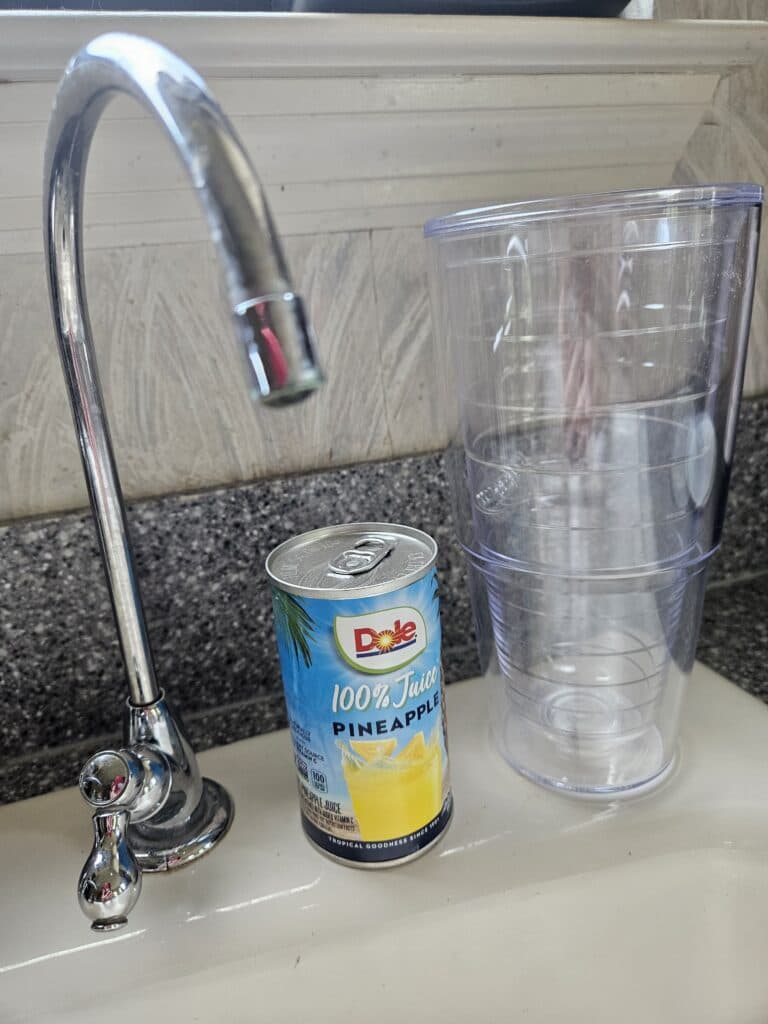
For dry, phlegmy, irritated or otherwise funky throat – or just to keep your normal throat hydrated & your voice feeling great during singing or speaking performance:
- Use 100% pineapple juice – with no other additives.
- Add 1 part 100% pineapple juice (Dole’s works fine) to 3 or 4 parts water. It doesn’t have to be exact, just make sure there’s quite a bit more water than juice.
- You don’t need to drink a lot of it, and you don’t have to drink it when you’re not using your voice.
- Just sip it between songs, speaking segments or takes when you are performing, rehearsing, talking a lot, or recording your voice.
- Bonus tip: If you have leftover juice, store it in a glass jar – not the tin can it came in! (You’ll probably only make that mistake once:)
But still, is Pineapple Juice for YOU?
If you try it and it DOES bother you – your throat itches, you experience more acid reflux, you just don’t like it for whatever reason… then it’s not for you. But if you USE IT… DILUTE IT!
Want more to protect your voice? Get my comprehensive list of Vocal Health Tips. It’s free!
What a great tip. I take it speakers can benefit from it as well. If you’ve ever taught a 2-hour class, this sounds like a great suggestion.
It is indeed great for speakers, Jan! And the speaking voice is often much more prone to fatigue, dehydration, and irritation than the singing voice. Thanks for bringing this up!
I was a singer for years, two music degrees, and I used pineapple juice which I strained through a coffee filter, because it is very fibrous. Always had a thermos of it handy at singing gigs, and it helped a lot. If I woke up with a bad throat on the day of a performance, I depended on it. At age forty, I decided to become an organist/choir director which I did up to the age of 80 when I retired from my last church job. During those last 40 years, I didn’t sing much. I often recommended my old pineapple juice trick to my choir singers. Now 83, I joined a very prestigious professional choir, and am loving singing again, I’m a tenor and am having a bit of a struggle trying to get my top more secure, but I vocalize more and it’s working. I’m going to go back and try my old pineapple fix, but on your advice I’ll mix it with water. I will still strain the fiber out. We’ll see what it will do for this old man. Cheers.
I’m not a singer, I’m a nutritionist. And this subject fascinates me. Heat treated, ie canned pineapple juice can’t contain bromelain as the heat processing kills the enzyme. It’s why the jello package used to say use canned pineapple in jello molds as the mold wouldn’t set with fresh pineapple due to the active enzymes. I worked with throat cancer patients and often recommended fresh papaya and pineapple smoothies to break up the thick ropey saliva that developed from radiation treatments. I got turned onto the idea from a Cuban patient who says he sucked on fresh papaya slices and obtained great relief from it. It’s interesting to me how the canned pineapple works because it’s a lot easier to obtain.
Robin, what a great comment, and a mystery to be sure! I do recommend eating fresh pineapple at gigs as well, but I know from vast experience that diluted canned juice does the trick, too. It hadn’t hit me until your comment that heat would kill the enzyme, but of course it would! I wonder if perhaps it doesn’t manage to kill all the enzyme, and that this may be why it still works, even at the heavy dilution I recommend to avoid acid reflux. I’m going to ask a chemistry professor I know to dig into it.